
How to Propagate Pothos Step by Step (Propagating Pothos Easily and Successfully)

How to Propagate Pothos Step-by-Step (Easy & Successful Pothos Propagation Guide)
Pothos (often referred to as Devil's Ivy or Epipremnum) is one of the most popular houseplants because it is low-maintenance, fast-growing, and extremely easy to propagate. In this step-by-step pothos propagation guide by WoodenBotanery, we’ll show you how to multiply your pothos so you can turn a single plant into a lush indoor jungle.
Introduction
Propagating pothos is one of the easiest ways to expand your houseplant collection without spending money on new plants. All it takes is a proper cut, a little patience, and the right rooting environment.
Why Pothos is Ideal for Propagation
Pothos is exceptionally successful at propagating mainly because:
- it quickly forms aerial roots,
- it adapts well to water, soil mixes, sphagnum moss, and perlite,
- it tolerates less-than-ideal growing conditions,
- it easily roots from stem nodes.
For beginners, it is one of the best houseplants for learning plant propagation.
When to Propagate Pothos
The best time for pothos propagation is during:
- Spring
- Summer
During these seasons, the plant has maximum energy and root development happens fastest. You can propagate in winter as well, but the rooting process will be slower.
How to Cut a Pothos Stem Cutting Correctly
Making a proper cut is essential for success.
Step-by-step:
- Select a healthy vine with at least 2–4 leaves,
- Locate a node – the small bump where leaves and aerial roots emerge,
- Using sharp, disinfected shears, cut about 1–2 cm (half an inch) below the node,
- Remove the bottom leaf so it won't submerge and rot in water.
👉 Roots will not form without a node, so its presence is absolutely crucial.

BotaneryLab Plant Cutting Propagation Station SIGNATURE - Leaf Motif WoodenBotanery
View details

BotaneryLab ELEMENT Oak - Wooden Plant Propagation Station WoodenBotanery Motif: B
View details

BotaneryLab™ ALCHEMY Designer Wooden Wall Propagation Station
View details

WoodenBotanery BotaneryLab™ PROPAGO: Hanging Wooden Plant Propagation Station
View details
Water Propagation Method
The easiest method for beginners.
Procedure:
- place your cutting (after letting the cut end callus!) into a glass with clean water,
- ensure the node is fully submerged,
- change the water once every 7 days,
- place in a bright spot with bright, indirect sunlight.
Roots usually appear within 1–3 weeks.
Soil Propagation Method
This method allows the plant to adapt faster to soil, but requires a bit more attention.
Procedure:
- prepare an airy soil mix (e.g., houseplant potting soil + perlite),
- insert the cutting so the node is buried in the soil,
- keep the soil consistently light and damp,
- maintain high humidity (e.g., using a mini greenhouse or plastic bag dome).
The advantage is that the plant develops stronger soil-adapted roots directly from the start.
How to Speed Up Root Growth
To speed up pothos propagation, try these helpful tips:
- warm temperatures (20–25 °C / 68–77 °F),
- bright indirect light,
- rooting hormones,
- higher ambient humidity,
- clean, sterile pruning tools.
Avoid overwatering—especially when propagating directly in potting soil.
Most Common Mistakes
When propagating pothos, avoid these frequent mistakes:
- taking a stem cutting without a node,
- dirty or stagnant water,
- burying leaves too deep in soil,
- direct sunlight burning the cutting,
- overwatering the soil mix.
When to Pot Up Pothos Cuttings
A water cutting is ready to be planted into soil when:
- roots are at least 3–5 cm (1.5–2 inches) long,
- there are multiple roots present,
- roots look firm and branched.
After potting up into soil, monitor the plant closely for a few days and maintain stable moisture levels.
FAQ
How long does pothos take to root?
In water, roots typically emerge in 1–3 weeks. In soil, the timeline is similar, though initial soil roots may develop slightly slower, but grow stronger.
Does a pothos cutting need a node to grow?
Yes. A node is absolutely essential. Without a node, a pothos leaf or stem cannot produce roots or new growth.

BotaneryLab Plant Propagation Holder MONOLITH Solid Walnut WoodenBotanery
View details
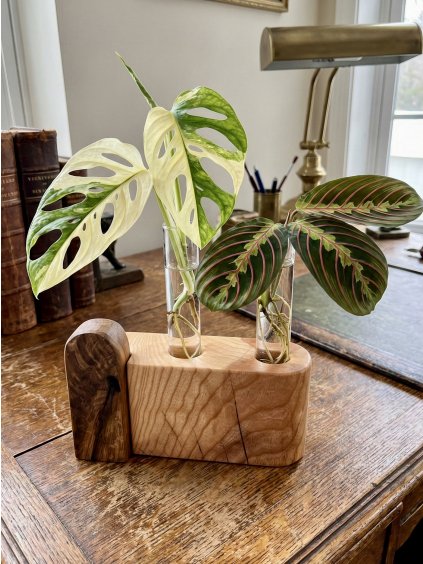
BotaneryLab Propagation Station GEMINI - for 2 Cuttings WoodenBotanery
View details

BotaneryLab ELEMENT Plum - Solid Wood Plant Propagation Station WoodenBotanery Motif: A
View details

Botanical Solitaire FESTUM FLORUM: Tabletop Test Tube Vase Stand made of Walnut and Ash for Floral Arrangements
View details